Saints & Scientists · Day 25 · Week 4
The Stove That Never Went Out
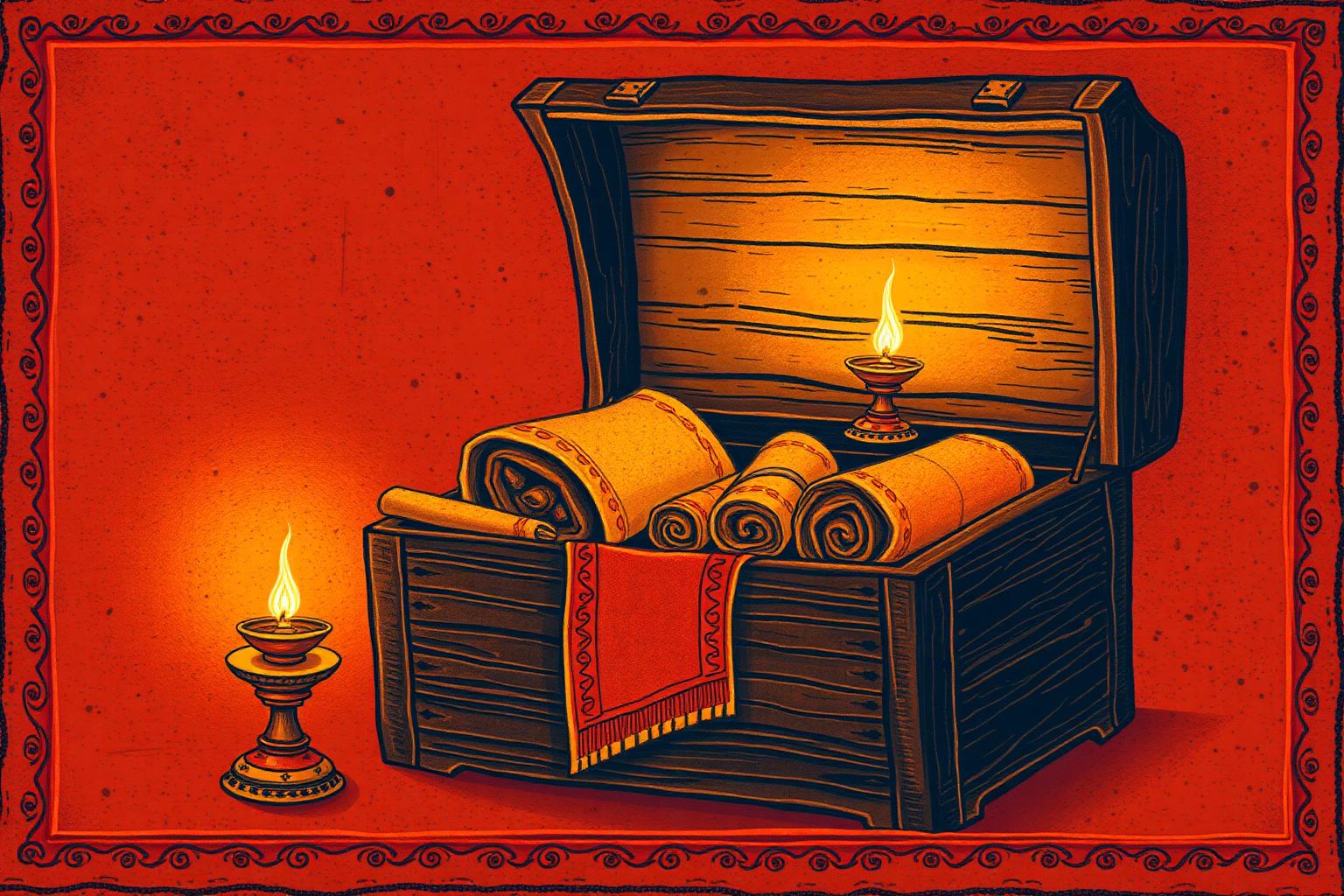
Ramalinga, called Vallalar, lives simply in Tamil Nadu. He says feeding the hungry is the best prayer.
In this story
- Characters
- Vallalar, The villagers of Vadalur
- Source text
- Life of Ramalinga Swamigal (Vallalar) and the Sathya Dharma Salai, Vadalur (1867)
- Value
- Generosity
- Read time
- 5 min read aloud
Day 25 at a glance
- Week
- Week 4 · day 4 of 7
- Trimester
- Trimester 1
- Baby this week
- The blastocyst settles into the uterine lining. The placenta and amniotic sac begin forming. Week 4 baby development
- Today's story
- The Stove That Never Went Out
- Garbh samvad
- “Welcome home, little seed. Take your time and grow gently.” Talk to your baby this week
Tamil tradition holds Vallalar's ever-burning stove at Vadalur as a living sign that kindness can be kept up day after day. Research on maternal calm suggests that small, regular acts of giving can lift a mother's mood and sense of meaning.
"As long as there are hungry people, let there be a fire here to cook for them."
A thin man in a plain white cloth knelt in the red earth of Vadalur and blew gently on a small fire until the flame caught.
This was in Tamil Nadu, about a hundred and sixty years ago. The man's name was Ramalinga, but people came to call him Vallalar, which means the generous one. He did not wear gold or silk. He wore only a simple white cloth, and he often covered his head with it too. He spoke softly. And he had one big idea that he could not stop thinking about.
"Hunger is a kind of pain," he would say. "When a person is hungry, God is hungry inside them. To feed someone is the best prayer of all."
In those years, there had been terrible famines in South India. The rains had failed. Many families had nothing to eat. Vallalar had seen children too weak to cry and old people sitting silent by the road. He could not forget them.
So in 1867, in the small village of Vadalur, near Cuddalore, he and his friends built a simple kitchen. It had a long, low roof, mud floors, and big cooking pots. He named it the Sathya Dharma Salai, the House of True Kindness.
On the first day, Vallalar lit the stove himself, kneeling down and blowing on the twigs until the fire caught.
"This fire must never go out," he told the people around him. "As long as there are hungry people, let there be a fire here to cook for them."
The rule of the kitchen was simple. Anyone could come. It did not matter what caste you were, what religion you followed, whether you were rich or poor, from near or far. If you were hungry, you sat down, and you were given a leaf plate of rice and sambar, hot and fresh.
Some people were surprised. In those days, people from different castes often would not sit down and eat together. But in Vallalar's kitchen, everyone sat in the same long rows on the same mud floor. A farmer next to a merchant. A grandmother next to a traveller. A child next to a holy man.
"We are all children of one light," Vallalar told them. "Why should we eat apart?"
He loved light. He often sat in front of a small oil lamp and gazed at its flame. He taught that God is like a great, kind light, and that the same light shines a little bit inside every person and every creature. That was why, he said, we must never be cruel to anyone, not even to an animal or a plant. He asked his followers not to eat meat, and not even to pluck flowers needlessly.
Every morning, the cooks came before dawn and fed the fire with fresh wood. Every day, the big pots of rice bubbled. Every day, hungry people walked along the dusty road to Vadalur and were fed.
Some nights the monsoon rain beat down on the roof. Some years there was hardly any money for rice. But somebody always came with a sack of grain, or a bundle of firewood, or a few coins. And the stove never went cold.
Vallalar lived simply all his life. He wrote beautiful songs in Tamil about kindness and light, which people still sing today. When he was older, he went quietly into a small room to rest in prayer, and closed the door. His followers say he became one with the kind light he loved. And his kitchen kept going, just as he had asked.
And here is the most wonderful part. That stove is still burning today. The fire that Vallalar lit in 1867 has been kept alight, morning after morning, for more than a hundred and fifty years. In Vadalur, people still come and sit in rows on the floor, and they are still given hot rice and sambar, free, whoever they are.
If you visit, you can see it: an everyday stove in an everyday kitchen, with an everyday fire. The cooks still feed it with wood every morning. Nobody makes a fuss. They just keep it going, so that the next hungry person can eat.
That evening, long ago, after the first day's meals were served, Vallalar sat alone in the quiet kitchen. The pots were washed. The floor was swept. And in the corner, under the big black pot, a small orange flame was still flickering, steady and warm, waiting for the morning.
Little one, a small kindness kept up every day can outlast us all, and you are already part of ours.
More from Saints & Scientists
4 min read · pregnancy & ages 4–8 · also known as “Vallalar aur kabhi na bujhne wala chulha”
Source: Story in the Saints & Scientists tradition
Behind this story
At Vadalur in Tamil Nadu, the Sathya Dharma Salai founded in 1867 by Ramalinga Swamigal, lovingly called Vallalar, the generous one, is known for a kitchen fire that has been kept going ever since, so that anyone who comes is fed. His teaching that a little of God's light shines in every being shaped the Samarasa Suddha Sanmarga path his followers keep today. Many saint stories revolve around visions; this one is about a stove, rice and sambar, and people of every caste and faith sitting in the same rows. For pregnancy, it is a warm picture of nourishment shared freely and of a fire that keeps faith.
- Theme
- generosity, kindness, nourishment
- For pregnancy week
- This story is for week 4 of pregnancy
- Updated
Characters
- Vallalar
- — A gentle saint who feeds everyone who comes.
- The villagers of Vadalur
- — They share in the kitchen's warm meals.
The moral
To feed someone who is hungry is the best prayer.
What to say to your baby
My little one, may your heart and hands always be open to share.
Ask them when they're older
What did Vallalar build in Vadalur?
Source: Life of Ramalinga Swamigal (Vallalar) and the Sathya Dharma Salai, Vadalur (1867)