Ramayana · Day 5 · Week 1
The Tiny Squirrel Helping Build Ram Setu
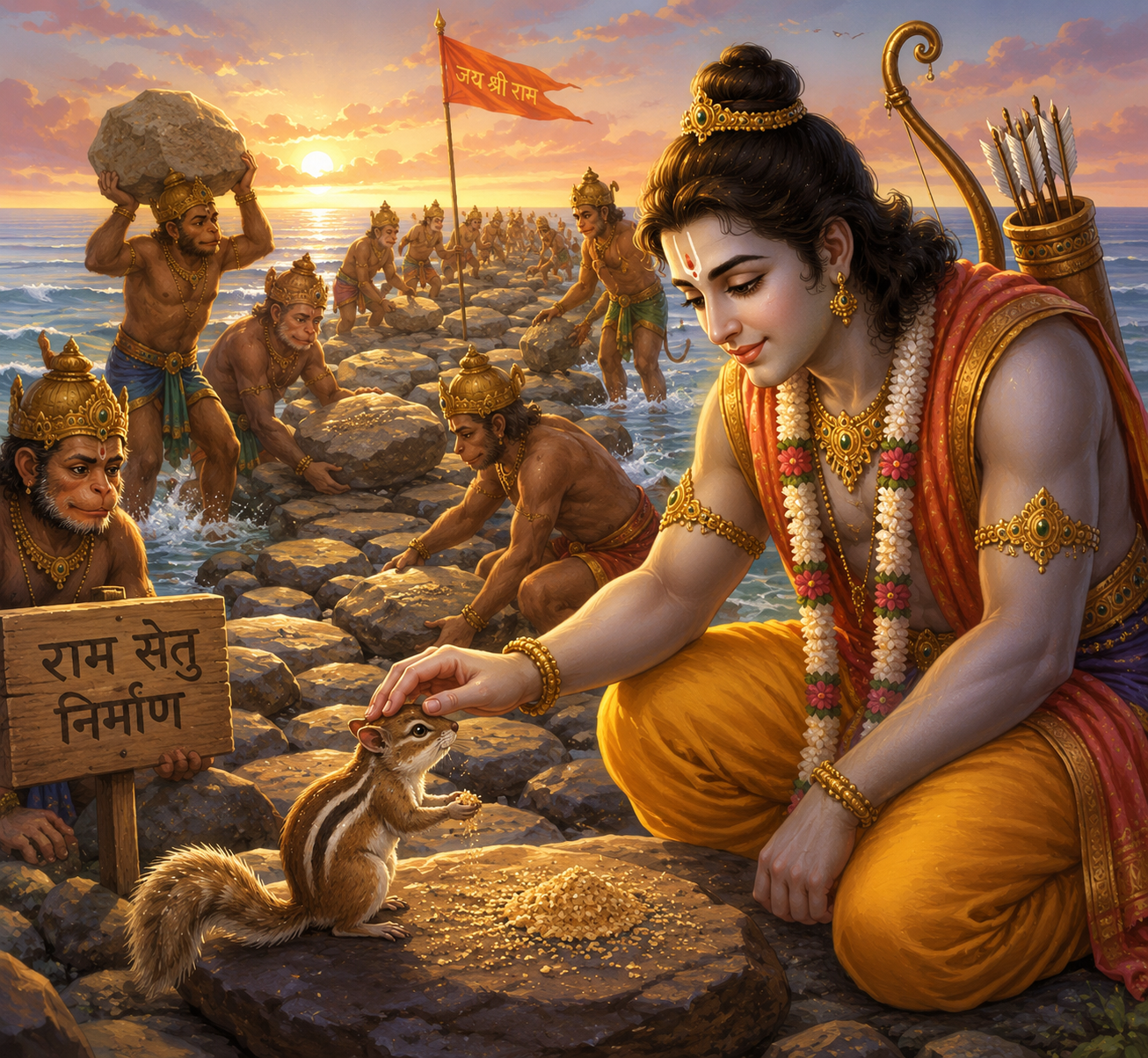
Rama's army builds a bridge of floating stones to Lanka. A tiny squirrel wonders how someone so small can help.
Moral of the story: No help is too small when it is given with love.
In this story
- Characters
- The little squirrel, Rama, Nala and Nila
- Source text
- Ramayana
- Value
- Kindness
- Read time
- 5 min read aloud
Day 5 at a glance
- Week
- Week 1 · day 5 of 7
- Trimester
- Trimester 1
- Baby this week
- Your cycle begins; the body prepares a welcoming home. Pregnancy is counted from the first day of your last period. Week 1 baby development
- Today's story
- The Tiny Squirrel Helping Build Ram Setu
- Garbh samvad
- “Whenever you arrive, little one, I want to be calm and ready for you.” Talk to your baby this week
Tradition holds that Rama honoured the squirrel's small effort as much as the vanaras' great ones. Research on maternal calm suggests that small daily habits, like a few slow breaths or a short story, can add up to a steadier pregnancy.
"I cannot carry rocks like you. I am helping in the way I can."
A small grey squirrel with a bushy tail sat under a palm tree at Rameswaram, at the very edge of the sea. All morning the beach in front of her had been full of noise. The waves crashed, the rocks thudded, and a thousand voices shouted "Jai Shri Ram!"
The voices belonged to the vanaras, a great army of monkeys and bears. They had come to help Prince Rama, a kind and brave prince whose wife, Sita, was being held far across the sea in Lanka. To reach her, they were building a bridge of stones over the water.
The squirrel watched the monkeys run past with rocks bigger than houses. She watched the bears roll whole trees down to the shore. At the water's edge stood two clever builders, the monkeys Nala and Nila. They wrote Rama's name on each stone, and the stones floated. Bit by bit, the bridge crept out towards the far shore.
Then the squirrel looked down at her own tiny paws. "What can someone as small as me do?" she thought. She sat for a while, her tail twitching, and then she had an idea.
She ran down to the water's edge and dipped herself in the shallow waves. Then she rolled in the dry sand until her fur was full of it. She scampered up onto the bridge, between the huge feet of the vanaras, and found a gap between two stones. There she shook herself hard, and a little shower of sand fell into the gap.
Then she ran back and did it again. Wet, roll, run, shake. Back again, and again, and again. All morning the little grey squirrel went up and down the beach, never stopping for long.
After a while, a big monkey stopped and laughed. "Little one, what are you doing? We are moving mountains here! What use are a few grains of sand?" The squirrel's whiskers trembled, and she felt very small. But she answered in her clear little voice.
"I cannot carry rocks like you. But the sand fills the gaps between your rocks, so the bridge is smooth for Rama's feet. I am helping in the way I can." And she went back to work.
The monkey shrugged and walked on. But someone else had been watching. Rama had been standing on the shore all morning. He had seen the boulders and the trees. He had also seen the small grey squirrel running up and down, up and down, without rest.
So he walked over and knelt in the sand. He held out his hand, and the squirrel, shy and shaking, climbed onto his palm. "Everyone here is helping," Rama said, loud enough for the vanaras to hear. "The one who carries a mountain and the one who carries a grain of sand. Each gives what they have. That is what makes it whole."
Then he gently stroked her back with three fingers. When he set her down, there were three pale stripes along her fur where his fingers had been. The squirrel looked at her new stripes, and for the first time that day, she did not feel small at all.
After that, the vanaras stopped laughing. Some of them even began to tip a little sand into the gaps themselves. They were careful, too, where they put their big feet, so as not to step on their small friend.
All day the work went on. By evening, the bridge stretched far out over the water. It was a long line of stones with Rama's name on each one, and a fine layer of sand smoothed the way between them.
As the sun went down behind the sea, the little squirrel curled up under her palm tree. Her paws were tired and her fur was full of salt. Out on the bridge, the last of the light shone on the sand she had carried, grain by grain, and on the three soft stripes along her back.
Little one, the small things you do with a full heart will always be enough.
More from Ramayana
3 min read · pregnancy & ages 3–8 · also known as “Ram Setu aur gilhari ki kahani”
Source: Ramayana · Traditional retelling
Behind this story
The squirrel at Ram Setu is not in Valmiki's Ramayana; it is a much-loved folk addition told across India and especially in the South, around Rameswaram, where the bridge to Lanka is said to have begun. Its famous ending explains the three stripes on the Indian palm squirrel's back, the marks of Rama's three fingers. While the epic praises Nala and Nila and the mighty vanaras carrying rocks, this tale belongs to the smallest helper, rolling in wet sand again and again to smooth the gaps, and to Rama's words that the one who carries a grain and the one who carries a mountain both help. It reminds an expectant mother that small daily efforts count deeply.
The tale is especially loved in Tamil Nadu, Kerala and Karnataka, and it is told at Rameswaram and Dhanushkodi, the shore from which the bridge is said to have begun; the line of shoals between India and Sri Lanka is still marked on maps as Rama Setu or Adam's Bridge. Children in many southern homes learn that the three pale stripes on a palm squirrel's back are the marks of Rama's fingers, and the story turns up in Tamil and Telugu folk songs, school readers and picture books, often shared around Rama Navami. During pregnancy, the squirrel's grains of sand become a sweet picture of everything a mother does each day — small, patient and lovingly noticed.
- Theme
- kindness, courage, calm
- For pregnancy week
- This story is for week 1 of pregnancy
- Updated
Characters
- The little squirrel
- — A tiny helper with a big heart.
- Rama
- — Who honours every small effort.
- Nala and Nila
- — The builders who make the stones float.
The moral
No help is too small when it is given with love.
What to say to your baby
Little one, you are small now, but every bit of your love will matter in this world.
Ask them when they're older
How did the little squirrel help build the bridge?
Source: Popular folk addition to the Ramayana (not in Valmiki), widely told in South India