Ramayana · Day 6 · Week 1
Hanuman Discovering His Inner Strength
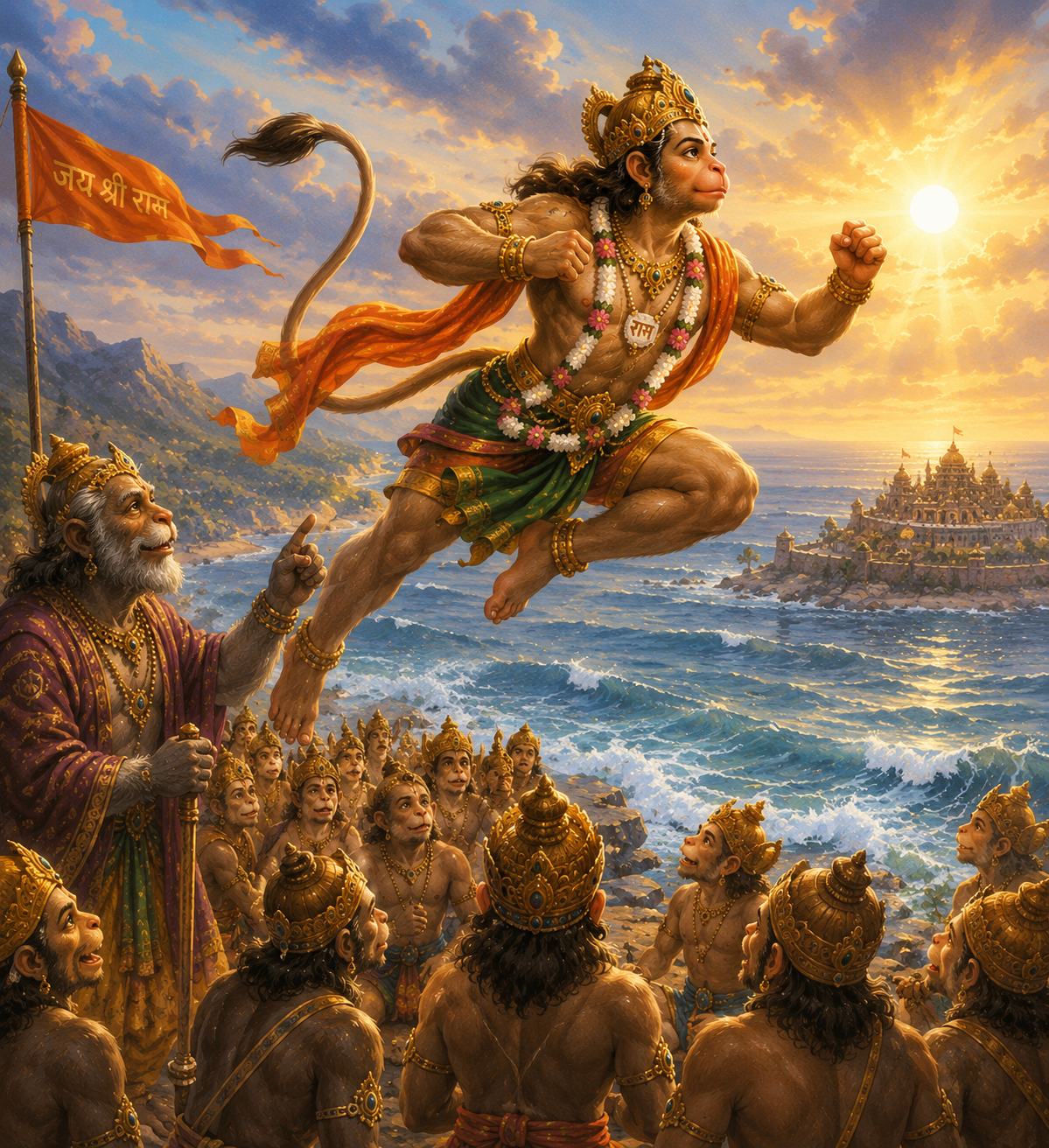
The vanaras reach the sea and wonder who can leap all the way to Lanka. Hanuman sits quietly, having forgotten his own great strength.
Moral of the story: We all carry strength inside us, and loving words help us remember it.
In this story
- Characters
- Hanuman, Jambavan, Angada
- Source text
- Ramayana
- Value
- Wonder
- Read time
- 5 min read aloud
- Also spelled
- Hanuman / Maruti / Bajrang / Anjaneya / Pavanputra / Bajrangbali
Day 6 at a glance
- Week
- Week 1 · day 6 of 7
- Trimester
- Trimester 1
- Baby this week
- Your cycle begins; the body prepares a welcoming home. Pregnancy is counted from the first day of your last period. Week 1 baby development
- Today's story
- Hanuman Discovering His Inner Strength
- Mantra
- Om (ॐ)
- Garbh samvad
- “Whenever you arrive, little one, I want to be calm and ready for you.” Talk to your baby this week
Tradition holds that Hanuman's great leap began with a few kind words from an elder who believed in him. Research on maternal calm suggests that encouragement from people around a pregnant woman can help her feel more confident and less anxious.
"He always had it," said Jambavan. "He only needed to hear it."
Hanuman, a big, strong vanara with kind eyes, sat a little apart from his friends on the rocks at the southern tip of India. Vanaras are the brave monkey people who had come to help Prince Rama. Together they stared at the sea, which stretched out grey and blue as far as they could see. Somewhere on the other side was the island of Lanka, and somewhere in Lanka was Rama's wife, Sita.
Angada, the young prince of the monkeys, stood up. "Who can jump across?" he asked.
One by one, the vanaras answered, measuring in yojanas, the old Indian way of counting long distances. "I can leap twenty yojanas," said one. "I can do thirty," said another. But Lanka was a hundred yojanas away, and no one could jump that far. So the vanaras fell quiet and looked down at the sand.
Hanuman said nothing. He did not think he could do it either. This was strange, because Hanuman had once been a very bold child.
As he sat there, he half remembered a morning long ago. When he was a baby, he had woken up hungry and seen the red sun rising. He thought it was a ripe mango, so he leapt up into the sky to take a bite! The gods were worried, and Indra, the king of the gods, sent his thunderbolt. Baby Hanuman tumbled back to earth with a hurt jaw. That is how he got his name, which means "the one with the jaw."
After that, the gods gave him many blessings. But as he grew, Hanuman was so full of energy that he played tricks on the quiet sages, the wise old men who prayed in the forest. He pulled their beards and spilled their water pots. At last one of them said, with a smile, "You will forget your own strength, until someone reminds you of it."
And so, sitting by the sea all those years later, he had forgotten.
Just then old Jambavan, the wise king of the bears, pushed himself up with his stick. His fur was white with age, and his eyes were gentle. He walked slowly over to where Hanuman sat.
"Hanuman," he said softly. "Why are you so quiet? Have you forgotten who you are?"
Hanuman looked up, surprised by the question.
"You are the son of Vayu, the wind," said Jambavan. "As a baby, you jumped all the way to the sun. You are strong, you are wise, and your heart belongs to Rama. This sea is nothing to you. The strength you need has been inside you all along."
The vanaras turned to watch. As Jambavan spoke, something changed in Hanuman's face. It was like watching dawn come up over a dark field. He remembered the sun. He remembered the wind lifting him. He remembered who he was.
So he stood up, and as he stood, he seemed to grow. His shoulders rose above the palm trees. The wind began to move around him, and birds took off from the rocks.
Next he climbed onto Mount Mahendra, a big hill by the shore, and pressed his feet into the stone. He folded his hands and closed his eyes. "Jai Shri Ram," he said quietly, which means "Victory to Lord Rama."
Then he bent his knees and leapt. The hill shook, and water splashed up from the pools between the rocks. Hanuman flew out over the sea, his arms stretched forward and his tail streaming behind him like a banner.
Clouds rushed past his face. Far below, the waves sparkled in the sun. Sea birds flew beside him for a while and then fell behind.
Even on the way, there were tests. First a mountain rose from the water to offer him rest, and Hanuman thanked it politely and flew on. Then a huge sea animal tried to block his path, so he made himself tiny and slipped right past. He did not stop. He did not doubt.
Back on the beach, the vanaras watched until he was only a small dot in the sky. Then he was gone. Jambavan sat back down on his rock and smiled. "He always had it," he said. "He only needed to hear it."
Far across the water, the green hills of Lanka rose out of the sea. As the evening light turned gold, Hanuman came down lightly among the trees, ready to find Sita.
There is strength in you too, little one, and we will be here to remind you of it.
More from Ramayana
4 min read · pregnancy & ages 3–8 · also known as “Hanuman ko apni shakti yaad aayi”
Source: Ramayana, Kishkindha Kanda · Traditional retelling
Behind this story
Jambavan reminding Hanuman of his strength is a key moment in the Kishkindha Kanda of Valmiki's Ramayana, and it is much loved in Hanuman Chalisa recitations and Hanuman Jayanti gatherings across India. Many Hanuman stories celebrate his mighty deeds. This one pauses just before the great leap, when the hero sits quiet and doubtful at the ocean's edge. The turn comes not from magic but from an old friend's simple question, 'Have you forgotten who you are?', and a childhood memory of leaping toward the sun, thinking it a ripe mango. Reading it in pregnancy, it encourages a mother to trust the strength she already carries, waiting only to be remembered.
Hanuman Jayanti falls on the full moon of Chaitra in much of North India, while Tamil Nadu and parts of the South celebrate it in the month of Margazhi, and Tuesdays and Saturdays are widely kept as his days. The Sundara Kanda, which follows this moment and tells of his leap to Lanka, is often read aloud at home for courage and blessings. Around Hampi, beside the Tungabhadra river, lies the region traditionally identified with Kishkindha, and the nearby Anjanadri hill is honoured by many as his birthplace. In temple art Hanuman is often shown mid-flight, one hand raised in blessing. Read in pregnancy, his story offers a simple reassurance: the strength you need is already inside you.
- Theme
- wonder, calm
- For pregnancy week
- This story is for week 1 of pregnancy
- Updated
Characters
- Hanuman
- — Strong and humble, he only needs reminding.
- Jambavan
- — The wise old bear king who believes in him.
- Angada
- — A young prince looking for a hero.
The moral
We all carry strength inside us, and loving words help us remember it.
What to say to your baby
My little one, you are strong and wonderful inside. Whenever you forget, I will remind you.
Ask them when they're older
What did Jambavan help Hanuman remember?
Source: Valmiki Ramayana, Kishkindha Kanda (Jambavan reminds Hanuman)