Puranas · Day 2 · Week 1
Dhruva’s Unshakable Determination
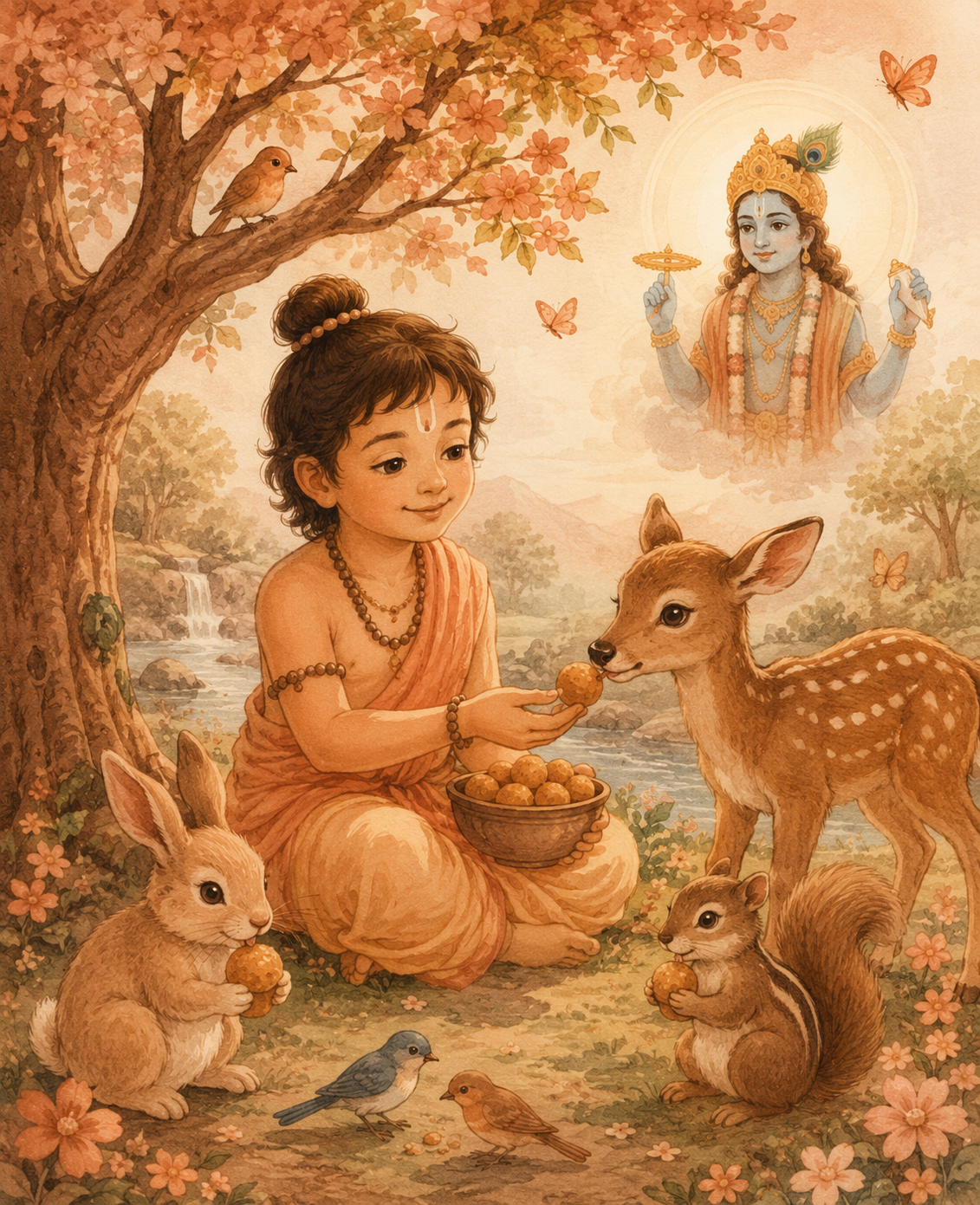
Little prince Dhruva is pushed away from his father's lap. He carries his hurt to his mother and decides to seek Lord Vishnu.
Moral of the story: Steady faith and determination lead us to what truly matters.
In this story
- Characters
- Dhruva, Queen Suniti, Lord Vishnu
- Source text
- Bhagavata Purana
- Value
- Patience
- Read time
- 5 min read aloud
- Also spelled
- Dhruva / Dhruv / Dhruva Tara / ध्रुव
Day 2 at a glance
- Week
- Week 1 · day 2 of 7
- Trimester
- Trimester 1
- Baby this week
- Your cycle begins; the body prepares a welcoming home. Pregnancy is counted from the first day of your last period. Week 1 baby development
- Today's story
- Dhruva’s Unshakable Determination
- Mantra
- Mahamrityunjaya Mantra
- Garbh samvad
- “Whenever you arrive, little one, I want to be calm and ready for you.” Talk to your baby this week
Tradition holds that Dhruva's patience began with his mother's steady words on the night he was hurt. Research on maternal calm suggests that slow breathing and a repeated, gentle phrase can help an expectant mother settle her own mind on difficult days.
Do not let the hurt make your heart hard.
Little Dhruva ran across the marble floor of the palace, his bare feet slapping on the cool stone. The court was full of music. His father, King Uttanapada, sat on his throne, and Dhruva's half-brother Uttama sat happily on the king's lap.
Dhruva wanted to sit there too. He reached up.
Before he could climb, Queen Suruchi, his stepmother, pulled him back.
"This lap is not for you," she said. "If you want a place like this, go and ask Lord Vishnu for it."
The music stopped. The king looked away and said nothing. Dhruva stepped back. His eyes filled with tears, and he ran.
He ran to the small rooms where his own mother, Queen Suniti, lived. She was sitting near the window with a basket of cotton. Dhruva put his head in her lap and cried.
"Why was I pushed away, Ma?"
Suniti stroked his hair. Her own eyes were wet, but her voice was steady.
"The world is not always fair, my son," she said. "But do not let this hurt make your heart hard. Your stepmother said one true thing. Lord Vishnu listens to every child who calls him with a clean heart. If you want a place no one can take from you, ask him."
Dhruva sat up. He was only five years old, but he had made up his mind.
That night, when the palace was asleep, he walked out through the gate and into the forest.
On the way, he met the sage Narada, who was walking with his veena on his shoulder.
"Where are you going so late, little prince?" Narada asked.
"To find Lord Vishnu," said Dhruva.
Narada smiled. He tried to talk the boy into going home. The forest was cold, he said, and the path was long. But Dhruva would not turn back. So Narada sat with him under a tree and taught him a simple mantra: Om Namo Bhagavate Vasudevaya. He showed him how to sit still, how to breathe slowly, and how to hold a picture of Vishnu in his mind.
Then Narada went on his way, and Dhruva went to the banks of the Yamuna at a quiet place called Madhuvana.
The first nights were hard. The wind was cold. Jackals called in the dark. He missed his mother's voice and the warm milk she gave him before bed. But each time he felt afraid, he remembered her words. Do not let the hurt make your heart hard.
So he sat. In the first month, he ate fruit and berries. In the second month, he ate only leaves. Then he drank only water. He said the mantra again and again, and he kept his mind on Vishnu.
Slowly, the forest got used to him. Deer grazed close by. A pair of mynas built a nest in the tree above his head. Squirrels ran over his knees. The boy did not move.
His prayer grew so strong and so steady that the old stories say even the gods could feel it. The earth itself seemed to lean towards this small, still child.
At last, Lord Vishnu came. He came riding on Garuda, with a soft blue glow around him, and he stood before the boy.
Dhruva opened his eyes. He wanted to speak, but he could not find any words. He had learned to pray, but he did not know how to praise. Vishnu gently touched the boy's cheek with his conch, and words of praise came pouring out of Dhruva like water from a spring.
"Dhruva," said Vishnu, "you came here hurt and angry, and you did not let it turn into hate. What would you like?"
Dhruva thought. The anger he had carried into the forest was gone. "I only wanted a place near my father," he said. "Now that I have seen you, I do not need anything else."
Vishnu smiled. "Go home. You will rule wisely. And one day, I will give you a place that no one can ever move you from."
Dhruva went home. His father ran to the gate and held him, sorry for his silence. Even Suruchi welcomed him. Dhruva grew up to be a kind and fair king.
And when his time came, Vishnu kept his promise. Dhruva became the Pole Star, the one star in the northern sky that does not move. Sailors and travellers still look for it to find their way.
On a clear night, a mother can step outside, point north, and find that one steady light. Tonight, it is shining for you too, little one.
More from Bhagavata Purana
4 min read · pregnancy & ages 3–8 · also known as “Bhakt Dhruv ki kahani”
Source: Bhagavata Purana, Book 4 · Traditional retelling
Behind this story
Dhruva's story is told in the fourth book of the Bhagavata Purana and the first book of the Vishnu Purana, and it lives on in the night sky: Dhruva Tara is the Indian name for the Pole Star, and the word dhruva itself means steady or fixed. The mantra Om Namo Bhagavate Vasudevaya, which Narada teaches him, is still chanted widely. What makes this tale distinctive is a child's journey from hurt to peace: Dhruva sets out wanting a place on his father's lap, yet once Vishnu appears he finds he wants nothing more at all. His mother Suniti's advice, not to let pain harden the heart, sits at its centre. That calm, steady devotion makes it a lovely companion during pregnancy.
In many homes the Pole Star is still pointed out to children as Dhruva Tara, the one star that stays in place while the others wheel around it, and in several wedding traditions the newly married couple are shown the steady Dhruva star together with Arundhati as a sign of a constant bond. Madhuvan, in the Braj region near Mathura, is remembered as the forest where young Dhruva sat in meditation, and pilgrims on the Braj parikrama still stop there. The story is a favourite in children's picture books, devotional songs and Puranic discourses. For an expecting mother, Dhruva's star is a gentle image to hold at night: a quiet point of calm that stays steady, however much the sky around it seems to turn.
- Theme
- patience, calm
- For pregnancy week
- This story is for week 1 of pregnancy
- Updated
Characters
- Dhruva
- — A determined little prince with a steady heart.
- Queen Suniti
- — His gentle mother who points him towards God.
- Lord Vishnu
- — He answers Dhruva's devotion with love.
The moral
Steady faith and determination lead us to what truly matters.
What to say to your baby
Little one, may your heart be steady like the Pole Star, always finding its way.
Ask them when they're older
Which star never moves in the night sky?
Source: Bhagavata Purana, Book 4; Vishnu Purana, Book 1