Ramayana · Day 8 · Week 2
The Sweet Bowl
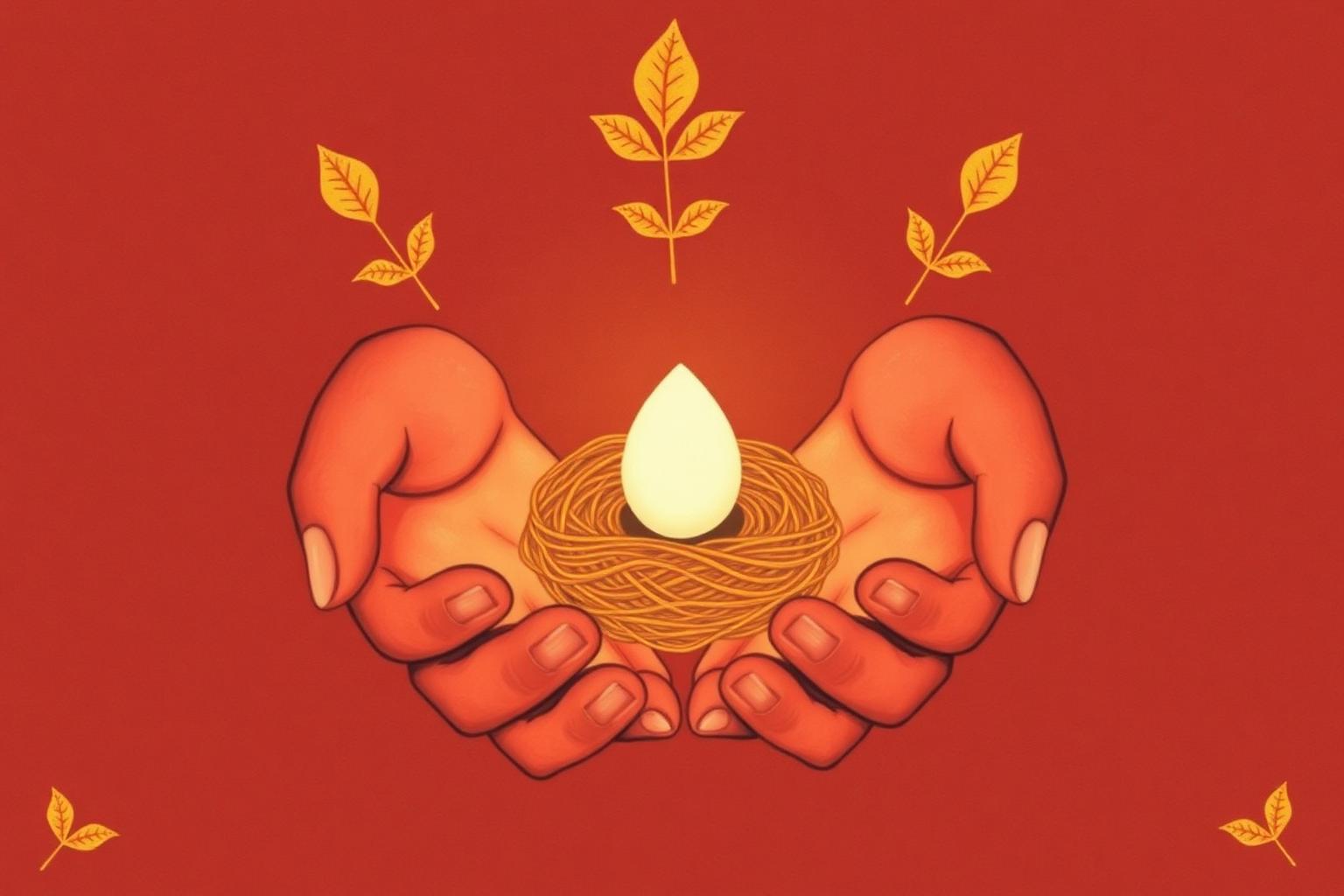
King Dasharatha and his three queens long for a child. Sage Vashistha advises a fire prayer led by Rishyashringa.
Moral of the story: Patient prayer and a loving wish welcome new life.
In this story
- Characters
- King Dasharatha, Kausalya, Kaikeyi and Sumitra, Sage Rishyashringa
- Source text
- Ramayana
- Value
- Devotion
- Read time
- 5 min read aloud
Day 8 at a glance
- Week
- Week 2 · day 1 of 7
- Trimester
- Trimester 1
- Baby this week
- Ovulation approaches. The egg that may become your baby is maturing. Week 2 baby development
- Today's story
- The Sweet Bowl
- Mantra
- Vishnu Sahasranama
- Garbh samvad
- “If you are on your way, you are already welcome.” Talk to your baby this week
Tradition holds that the birth of Rama and his brothers began with a family's long, patient hope and a shared bowl of payasam. Research on maternal calm suggests that naming and sharing the feelings of waiting, rather than carrying them alone, can ease a mother's worry.
He carried the bowl the way you would carry a sleeping baby.
King Dasharatha stood on his balcony and watched the Sarayu River turn gold in the evening light. Below him, Ayodhya was busy and happy. Lamps were being lit in the market. Children were being called home for dinner.
But in the king's palace, there were no children.
Dasharatha had ruled well for many years. His people were fed and safe. He had three queens, Kausalya, Kaikeyi and Sumitra, and he loved them all. Yet all of them carried the same quiet ache. Their gardens were full of flowers, their rooms were full of silk, but there was no cradle, and no child's laugh in the halls.
The king's hair was turning grey. He had prayed. He had given food and cows to the poor. He had done everything he knew how to do.
Queen Kausalya came and stood beside him at the balcony. She did not say anything. She only put her hand on his arm. They watched the river together until the light was gone.
The next day, Dasharatha called his teacher, the sage Vashistha.
"I have everything a king could want," he said, "except the one thing I long for most."
Vashistha thought for a while. Then he said, "There is an old fire ceremony called the Putrakameshti yagna. It is a prayer for children. Invite the sage Rishyashringa to lead it. He is a man of great goodness."
A space was cleared on the bank of the Sarayu. Workers built a square fire pit of bricks. Rishyashringa came, a gentle man who had grown up deep in the forest. The fire was lit.
For many days, the priests chanted. They poured ghee into the flames, and handfuls of rice and barley, and sweet-smelling herbs. Smoke curled up into the sky. The king and his three queens sat in front of the fire with folded hands. They did not talk much. They simply prayed, with all the hope they had saved up over the long years.
On the last day, as the final offering went into the fire, the flames changed. They rose up tall and bright, brighter than the sun. Everyone stopped chanting.
Out of the fire stepped a shining figure, dressed in red, with a calm and kind face. In his hands was a golden bowl, and from the bowl came the smell of warm milk, rice, sugar and cardamom.
"King Dasharatha," the figure said, in a voice deep and gentle, "the gods have heard your prayer. This is payasam, made in heaven. Share it with your queens. You will have sons who will bring goodness to the world."
Dasharatha's hands shook as he took the bowl. It was warm. He knelt, and tears ran down his face. When he looked up, the shining figure had gone back into the fire.
For a moment no one moved. Then the king stood up, holding the bowl carefully against his chest, and walked slowly back to the palace. He did not run. He carried the bowl the way you would carry a sleeping baby.
In his rooms, he called for his queens. They came in quietly, their eyes wide. The room filled with the smell of cardamom.
Dasharatha poured half of the payasam into a silver cup for Kausalya, his eldest queen. Her hands trembled as she took it.
He gave half of what was left to Kaikeyi. Her proud, bright face became soft.
The rest he gave to Sumitra, who had always looked after the others. The story says she received two portions, and her quiet face lit up with joy.
The three queens looked at one another. For years they had shared a sadness. Now they shared something new. They ate the payasam slowly, spoon by spoon.
In time, Kausalya gave birth to Rama. Kaikeyi gave birth to Bharata. And Sumitra, who had received two portions, gave birth to twins, Lakshmana and Shatrughna.
But that night, all of that was still to come. That night there was only a quiet room, three women sitting close together, and an empty golden bowl on the table, still warm, still smelling sweetly of cardamom.
Some of the sweetest things are worth the wait, little one, and you are one of them.
More from Ramayana
4 min read · pregnancy & ages 3–8 · also known as “Raja Dashrath ka putrakameshti yagya”
Source: Ramayana, Bala Kanda · Traditional retelling
Behind this story
The Putrakameshti yagna opens the Bala Kanda of Valmiki's Ramayana, where King Dasharatha of Ayodhya, longing for children, holds a great fire ceremony on the banks of the Sarayu with the sage Rishyashringa. It is one of the best known birth stories in Indian tradition, and the bowl of payasam from the sacred fire is often remembered when families pray for a child. What makes this episode unique is the sharing: the king divides one bowl among three queens, and from that single offering come four princes, Rama, Bharata, Lakshmana and Shatrughna. The tale's sweetness lies in queens who had shared years of waiting now sharing joy. Few stories feel more fitting for pregnancy, with its hopeful longing and the fragrance of milk and cardamom.
- Theme
- devotion, wonder, courage
- For pregnancy week
- This story is for week 2 of pregnancy
- Updated
Characters
- King Dasharatha
- — A good king whose heart longs for a cradle.
- Kausalya, Kaikeyi and Sumitra
- — Three queens who share the sweet blessing.
- Sage Rishyashringa
- — The gentle sage who leads the fire prayer.
The moral
Patient prayer and a loving wish welcome new life.
What to say to your baby
My little one, you are our sweet blessing. We waited and prayed for you with all our love.
Ask them when they're older
What came out of the fire for the queens?
Source: Valmiki Ramayana, Bala Kanda