Jain · Day 21 · Week 3
Mahavira and the Angry Snake
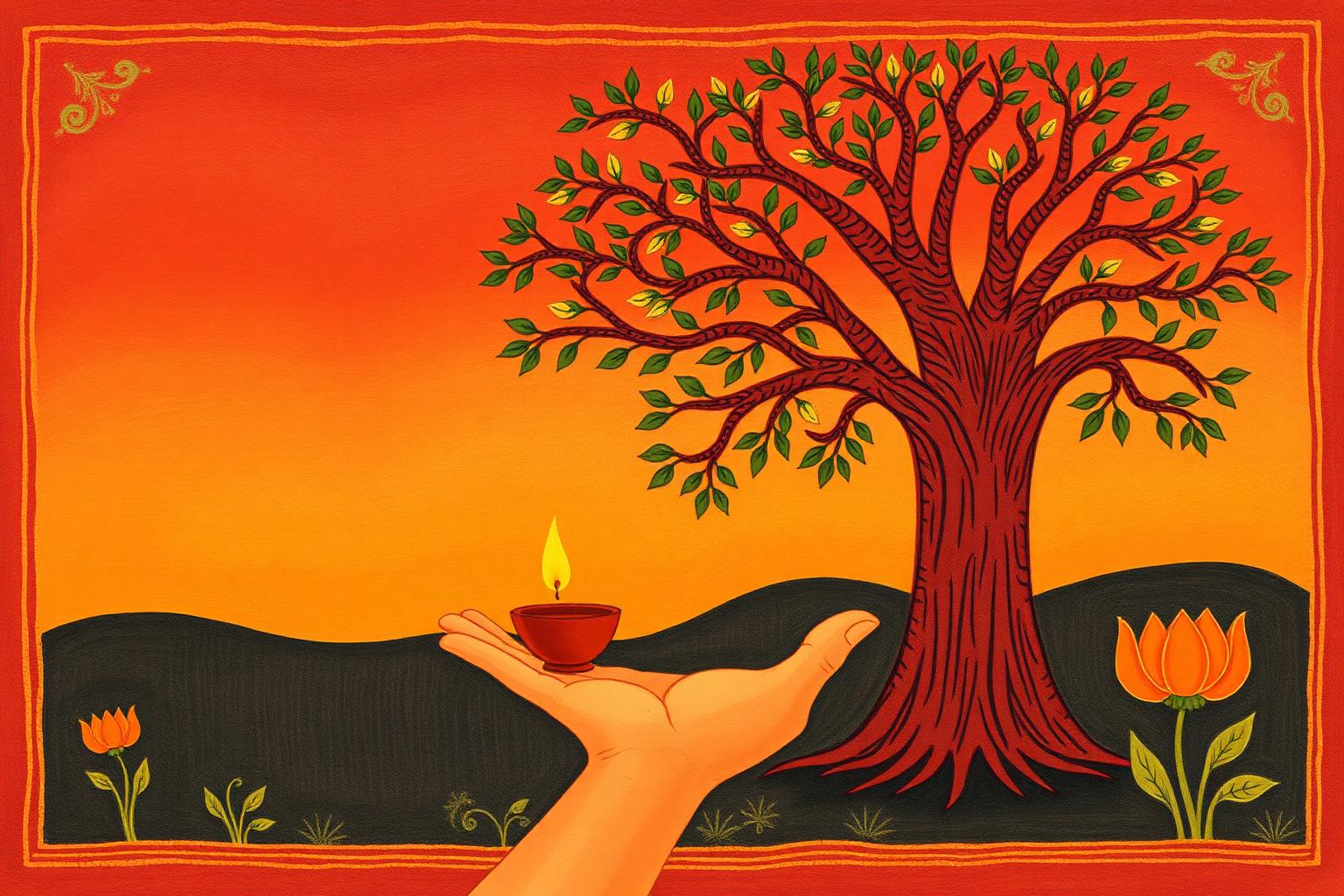
The gentle monk Vardhamana walks carefully so he won't step on even an ant. Cowherds warn him about the angry snake Chandkaushik, but he walks on calmly.
Moral of the story: Gentleness can calm even the angriest heart.
In this story
- Characters
- Mahavira (Vardhamana), Chandkaushik, The cowherds
- Source text
- Jain kathas
- Value
- Patience
- Read time
- 5 min read aloud
- Also spelled
- Mahavira / Mahavir / Vardhamana / Tirthankara / Bhagwan Mahavir / Vira
Day 21 at a glance
- Week
- Week 3 · day 7 of 7
- Trimester
- Trimester 1
- Baby this week
- Conception. A single cell begins dividing, carrying everything that makes your baby unique. Week 3 baby development
- Today's story
- Mahavira and the Angry Snake
- Mantra
- Mahamrityunjaya Mantra
- Garbh samvad
- “Whenever you arrive in my knowing, know you were wanted from the start.” Talk to your baby this week
Jain tradition holds that ahimsa, gentle non-harm, can soften even the fiercest anger, and Chandkaushik's story is told to children to show it. Research on maternal calm suggests that answering tension with a slow breath and a soft voice can help settle difficult moments at home.
"Chandkaushik," he said softly. "Wake up. Calm down."
The cowherds at the edge of the forest waved their arms and shouted, "Stop! Don't go that way!" But the quiet man in the forest path only smiled at them and kept walking.
His name was Vardhamana. Later, the whole world would call him Mahavira, the great hero, and the Jain people would remember him as the twenty-fourth Tirthankara, a teacher who showed the way across the river of life. But on that day, more than two and a half thousand years ago, he was simply a wandering monk with bare feet and no possessions at all. He had given away his palace, his fine clothes and his jewels. He walked from village to village in the land of Magadha, in what is now Bihar, speaking little and harming nothing. He walked carefully, looking at the ground, so that he would not step on even an ant.
"Swami," the cowherds called, running after him. "That path goes through the forest where Chandkaushik lives!"
Chandkaushik was a snake. Not an everyday snake, the people said. He was huge, and he was the angriest creature in the whole country. The old stories say that just one look from his eyes could send the birds fleeing from the sky. Because of him, no one used that forest path anymore. The grass had grown over it. The birds had gone quiet. Even the trees around his hole had dried and turned grey.
Mahavira listened to the cowherds kindly. Then he said, "Thank you for caring about me." And he walked on into the forest.
The path was very still. There was no birdsong. Dry leaves crackled under his feet. At last he came to a clearing with a big anthill in the middle of it, and a dark hole at its base. Mahavira stood quietly beside it, closed his eyes, and began to meditate. He stood as still as a tree.
Inside the hole, Chandkaushik woke up. He smelled a human. He was furious. How dare anyone come to his forest!
He slid out of the hole, long and dark, and raised his head high. He hissed. He glared at the monk with his burning eyes, waiting for him to run away screaming, the way everyone always did.
But Mahavira did not run. He did not scream. He did not even open his eyes. He just went on standing there, calm and quiet, breathing slowly.
The snake was surprised. Nobody had ever stood still before him. He grew even angrier. He hissed louder. He glared harder. Still the monk stood, peaceful as a mountain.
At last, in a rage, Chandkaushik lunged forward and bit Mahavira on the foot.
And then something very strange happened. The old stories say that instead of red blood, white milk flowed from the bite, as white and gentle as a mother's milk. Mahavira's heart was so full of love, even for this angry snake, that there was no anger anywhere in him for the poison to find.
Chandkaushik pulled back, confused. He looked up at the monk's face.
Mahavira opened his eyes. He did not look frightened. He did not look cross. He looked at the snake the way a mother looks at a child who has had a terrible tantrum.
"Chandkaushik," he said softly. "Wake up. Calm down. Think about what you are doing."
His voice was so gentle that something inside the snake went quiet. For the first time in a very long time, Chandkaushik was not angry. He looked at the grey, withered trees around his hole. He thought of all the animals he had frightened. He remembered, the Jain stories say, his own earlier lives, when anger had first begun to grow in him, little by little, until it had swallowed him whole.
Slowly, the great snake lowered his head to the ground in front of Mahavira's feet. He bowed.
From that day on, Chandkaushik changed. He decided he would never hurt anyone again. He kept his head inside his hole, so that his eyes could not frighten anyone. He lay so still and peaceful that, little by little, the forest came back to life around him. The grass grew green. The birds returned. And the cowherds, seeing that the snake no longer moved, came and left offerings of milk and sweets beside his hole, and walked the forest path again without fear.
Mahavira walked on to the next village, as quietly as he had come, looking carefully at the ground so as not to step on any ant.
Behind him, in the clearing, a bird landed on the anthill and began to sing, for the first time in years.
Calm is stronger than anger, little one, and there is a calm, kind heart waiting for you here.
More from Jain kathas
4 min read · pregnancy & ages 3–8 · also known as “Mahavir aur Chandkaushik naag ki kahani”
Source: Jain kathas · Traditional retelling
Behind this story
The meeting of Mahavira and Chandkaushik comes from Jain accounts of the life of the twenty-fourth Tirthankara, and it is retold every year at Mahavir Jayanti and during Paryushan, often painted in temple murals and children's books. Many hero tales end with a fierce creature being overcome; this one ends with the creature transformed. The monk simply stands still beside the hole, answers rage with a soft 'wake up, calm down', and the snake remembers how anger had swallowed him. The Jain image of milk instead of anger flowing from Mahavira is its most loved detail. Its picture of steady calm turning a whole forest green suits the peaceful mood of pregnancy.
- Theme
- patience, calm, wisdom
- For pregnancy week
- This story is for week 3 of pregnancy
- Updated
Characters
- Mahavira (Vardhamana)
- — A gentle monk who harms no living being.
- Chandkaushik
- — An angry snake who finds peace.
- The cowherds
- — Worried villagers who try to warn him.
The moral
Gentleness can calm even the angriest heart.
What to say to your baby
Little one, may you meet anger with calm and love, just as Mahavira did.
Ask them when they're older
How did Mahavira help the angry snake?
Source: Jain tradition, from the life of Mahavira