Story collection
Pregnancy stories about patience
Top 10 to start with
- Day 7: A name not yet spoken
Tradition holds that the naming ceremony comes after birth, and that the months before are for getting to know the baby with patience.
- Day 13: The Sparrow's Plea
Many Indian traditions hold that asking with humility is a form of prayer, and that a mother's request carries special weight.
- Day 21: Mahavira and the Angry Snake
Jain tradition holds that ahimsa, gentle non-harm, can soften even the fiercest anger, and Chandkaushik's story is told to children to sh…
- Day 24: The Little Bird and the Monsoon Rain
Indian tradition has always watched for small signs of the monsoon, like ants moving their eggs and peacocks calling, and treated the wai…
- Day 27: The Hands That Wait
Tradition holds that Phalavati's patient love and open-handed giving were what Krishna truly received, more than any fruit.
- Day 30: The Rooster Who Called the Sun
Khasi tradition holds that the Sun returned not to the strongest voice but to the kindest, and this tale is still told in the hills of Me…
- Day 31: The Hornbill Mother's Hollow
Great hornbills of the Western Ghats really do seal the mother inside the nest while the father brings her food, and many forest communit…
- Day 44: Bhagiratha Brings the Ganga
Tradition holds that the Ganga reached the earth through one king's long patience and Shiva's gentle strength.
- Day 45: The Monkeys Who Watered the Garden
Buddhist tradition tells this Jataka with a smile to show that patience and trust are part of wisdom.
- Day 53: Vidura and the Two Saplings
Tradition holds Vidura as the Mahabharata's voice of calm, fair advice.
Compare at a glance
| Story | Read time | Value | Trimester |
|---|---|---|---|
| Day 2: Dhruva’s Unshakable Determination | 5 min | Patience | 1st |
| Day 7: A name not yet spoken | 5 min | Wonder | 1st |
| Day 13: The Sparrow's Plea | 5 min | — | 1st |
| Day 21: Mahavira and the Angry Snake | 5 min | Patience | 1st |
| Day 24: The Little Bird and the Monsoon Rain | 5 min | — | 1st |
- Day 2: Dhruva’s Unshakable Determination
Tradition holds that Dhruva's patience began with his mother's steady words on the night he was hurt. Research on maternal calm suggests that slow breathing and a repeated, gentle phrase can help an expectant mother settle her own mind on difficult days.
- Day 7: A name not yet spoken
Tradition holds that the naming ceremony comes after birth, and that the months before are for getting to know the baby with patience. Research on maternal calm suggests that talking to the baby and slowing down to notice small things can help a mother feel more connected and less rushed.
- Day 13: The Sparrow's Plea
Many Indian traditions hold that asking with humility is a form of prayer, and that a mother's request carries special weight. Research on maternal calm suggests that naming a worry out loud and asking for help, rather than struggling alone, can ease stress during pregnancy.
- Day 21: Mahavira and the Angry Snake
Jain tradition holds that ahimsa, gentle non-harm, can soften even the fiercest anger, and Chandkaushik's story is told to children to show it. Research on maternal calm suggests that answering tension with a slow breath and a soft voice can help settle difficult moments at home.
- Day 24: The Little Bird and the Monsoon Rain
Indian tradition has always watched for small signs of the monsoon, like ants moving their eggs and peacocks calling, and treated the waiting as part of the season. Research on maternal calm suggests that noticing small, present details can ease the restlessness of waiting, including the long wait of pregnancy.
- Day 27: The Hands That Wait
Tradition holds that Phalavati's patient love and open-handed giving were what Krishna truly received, more than any fruit. Research on maternal calm suggests that generosity and looking forward to something with hope can both support a mother's sense of wellbeing.
- Day 30: The Rooster Who Called the Sun
Khasi tradition holds that the Sun returned not to the strongest voice but to the kindest, and this tale is still told in the hills of Meghalaya. Research on maternal calm suggests that gentle, patient words, both to ourselves and to others, can soften tense moments at home.
- Day 31: The Hornbill Mother's Hollow
Great hornbills of the Western Ghats really do seal the mother inside the nest while the father brings her food, and many forest communities honour them as faithful partners. Research on maternal calm suggests that steady, everyday support from a partner can help an expectant mother feel safe and cared for.
- Day 32: Young Rama and the Mango Seed
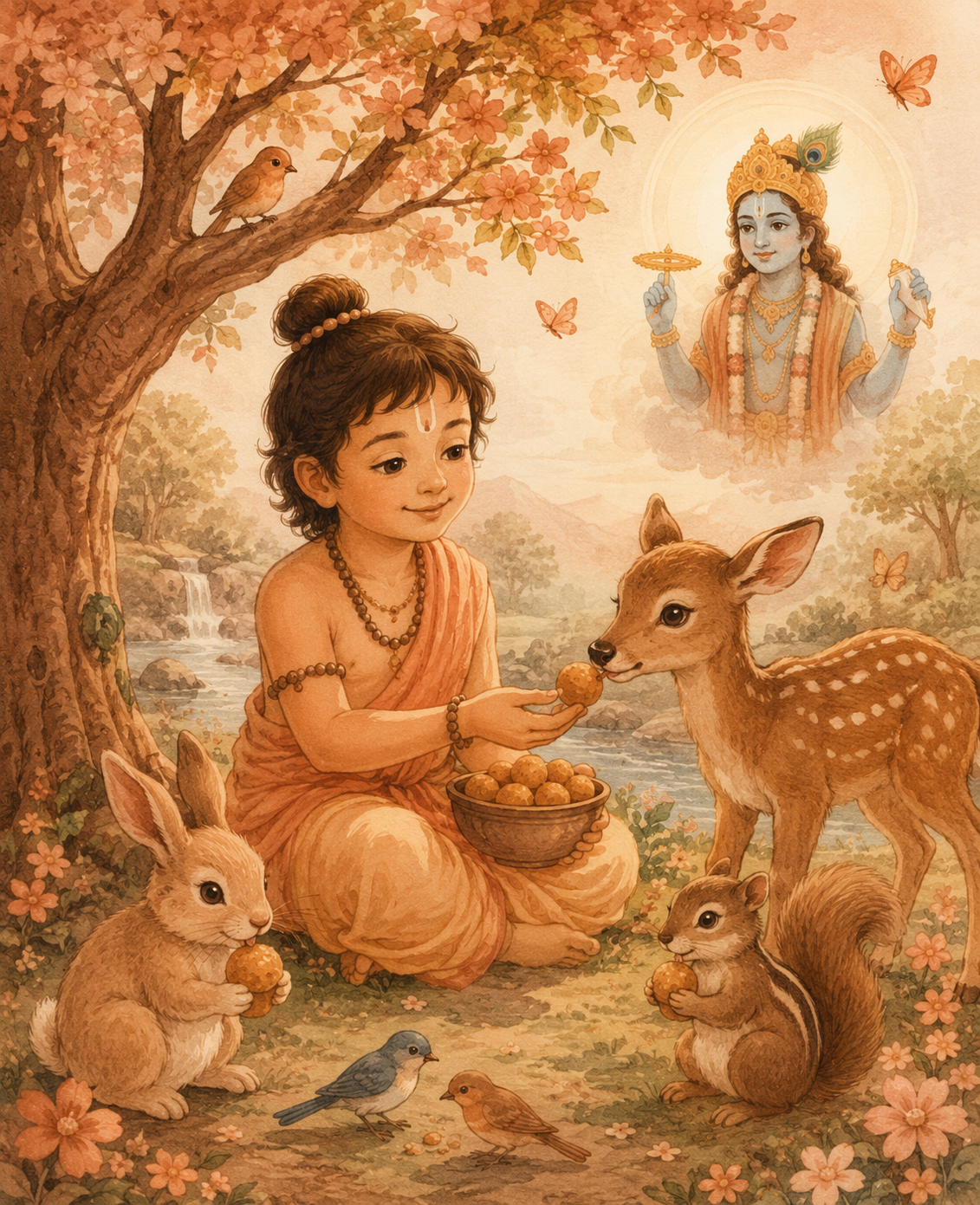
Tradition holds Rama as a model of calm patience, even as a boy. Research on maternal calm suggests that steady, unhurried routines can help a mother feel more at ease during the long months when growth cannot be seen.
- Day 44: Bhagiratha Brings the Ganga
Tradition holds that the Ganga reached the earth through one king's long patience and Shiva's gentle strength. Research on maternal calm suggests that a slow, steady approach to big tasks, rather than rushing, can help a mother stay steadier through the months of pregnancy.
- Day 45: The Monkeys Who Watered the Garden
Buddhist tradition tells this Jataka with a smile to show that patience and trust are part of wisdom. Research on maternal calm suggests that constant checking and worrying can raise stress, and that learning to trust quiet, unseen growth can bring some ease.
- Day 48: Sita and the Garden of Care
Indian tradition holds the parijat as a sacred tree whose fallen flowers are gathered for worship, never plucked. Research on maternal calm suggests that daily, gentle care routines, for a plant or for oneself, can bring a sense of steadiness during pregnancy.
- Day 53: Vidura and the Two Saplings
Tradition holds Vidura as the Mahabharata's voice of calm, fair advice. Research on maternal calm suggests that letting go of the need to predict the future, and focusing on today's care, can ease anxiety during pregnancy.
- Day 64: Yudhishthira and the Honest Answer
Tradition holds Yudhishthira's honest "not yet" as a lesson in living values rather than reciting them. Research on maternal calm suggests that being patient with ourselves as we learn new things, including parenting, can reduce stress and self-criticism.
- Day 67: The Wise Stag Lakkhana
The Buddha told the Lakkhana Jataka to show that careful, patient leadership keeps everyone safe. Research on maternal calm suggests that slowing down and planning gently, rather than rushing, can reduce stress for the whole family.
- Day 77: Parvati's Patient Heart
In the Puranas, Parvati's tapas is honoured as the power of steady devotion, and she is worshipped as a mother of deep patience. Pregnancy is also a season-by-season waiting, and research on maternal calm suggests that slow, steady practices like quiet breathing can make that waiting gentler.
- Day 84: Chandra and the Forest Bell
Tradition holds that the evening bell, the conch and the sandhya lamp mark a gentle pause between day and night. Research on maternal calm suggests that slowing the breath before rest can help the body unwind, just as Chandra learned to breathe before ringing her bell.
- Day 85: The Mango Tree's Year
In Indian homes the mango tree is a symbol of abundance, and its leaves hang in toran over doorways at happy occasions. Pregnancy also unfolds in seasons, and research on maternal calm suggests that accepting rest as part of growth can ease the pressure to always be doing more.
- Day 86: The Potter by the River
Tradition holds the potter's wheel as an old image of patient shaping, and many Indian sayings compare a child to soft clay in loving hands. Research on maternal calm suggests that a few slow breaths when the mind races can help, just as they helped Dev at his wheel.
- Day 87: Janaki Ammal's Sugarcane
Janaki Ammal's patient science helped Indian farmers and protected a precious forest, and her life shows the quiet strength of steady work. Research on maternal calm suggests that seeing waiting as active growth, rather than empty time, can make long months feel gentler.
- Day 88: Jakanachari and the Hidden Frog
The legend of Jakanachari is told across Karnataka alongside the famous carvings of Belur and Halebidu, and tradition holds it as a lesson in humility and family. Research on maternal calm suggests that feeling close to loved ones matters, and this story is a gentle nudge to make room for home.
- Day 89: Kabir and the Woven Cloth
Kabir's dohas have been sung across North India for more than five hundred years, and tradition holds that he wove his devotion right into his daily work. Research on maternal calm suggests that slow, repetitive actions paired with a calming word or breath can help settle the mind.
- Day 95: Narada and the Forest Robber
Indian tradition honours Valmiki as the Adi Kavi, the first poet, who gave the world the Ramayana after his heart was transformed. The story reminds parents that patient belief in someone's goodness can help that goodness grow, a gentle thought to carry into raising a child.
- Day 100: Ganesha Writes the Great Story
Tradition holds that Ganesha wrote the Mahabharata as Vyasa spoke it, and his broken tusk is honoured as a sign of loving sacrifice for learning. Research on maternal calm suggests that reading aloud is a gentle, bonding routine, and every story you share is a seed for your baby.
- Day 102: The Snow Leopard's Lesson
Snow leopards are treasured in Ladakh, where mothers raise their cubs patiently among the high rocks. Tradition holds that children learn best with a loving elder close by, and research on maternal calm suggests that a patient, unhurried attitude toward learning eases pressure on parents and children alike.
- Day 104: Lal Ded's Water Pot
Lal Ded's vakhs are loved by Kashmiris of every faith, and tradition holds her as a voice of inner peace that hardship could not shake. Research on maternal calm suggests that singing and slow, rhythmic walking can soothe the nervous system, even on heavy days.
- Day 106: The Coconut That Crossed the Sea
In Kerala the coconut palm is called kalpavriksha, the tree that gives everything, and the coconut is offered at almost every auspicious beginning. Research on maternal calm suggests that imagining gentle rocking and the sound of waves can be relaxing, which makes this a soothing story for a full belly at night.
- Day 109: Arjuna and the Silent Teacher
The Bhagavad Gita, which Arjuna later received, often compares a steady mind to still water, and tradition holds stillness as the root of clear action. Research on maternal calm suggests that simply sitting and breathing, without forcing thoughts away, can help an anxious mind settle.
- Day 111: The Deer Who Chose Peace
The Jataka tales often show the Bodhisatta as an animal leader who solves conflict through patience and fairness rather than force. Research on maternal calm suggests that calm, cooperative responses lower stress for everyone involved, a lesson as useful in a busy household as in a dry valley.
- Day 114: Bhima and the Small Seed
Tradition often pairs Bhima's great strength with lessons in gentleness, and this tale shows that the strongest love protects rather than forces. Research on maternal calm suggests that letting go of the urge to control every detail can ease worry, especially in the long, quiet weeks of waiting.
- Day 116: The Elephant and the Narrow Bridge
Jataka tales often show the Bodhisatta's strength expressed through restraint and care for the smallest creatures. Research on maternal calm suggests that patient, gentle responses help both parents and children feel safe, and this story is a picture of that patience.
- Day 119: Yudhishthira and the Honest Merchant
Yudhishthira is remembered in the Mahabharata as Dharmaraja, the king devoted to truth, and this tale honours the everyday honesty of everyday people. Research on maternal calm suggests that living in line with your values supports peace of mind, which is a gentle thing to carry into sleep.
- Day 121: The Peacock Who Waited for Rain
In India the peacock's dance is a much-loved sign of the monsoon, and tradition celebrates the first rain as a time of renewal. Research on maternal calm suggests that facing a long wait alongside supportive people makes it easier to bear, just as Mayur's friends found.
- Day 123: Asima Chatterjee's Garden of Medicines
Asima Chatterjee's patient study of Indian medicinal plants opened doors for women in Indian science. Tradition has long treasured plants like tulsi and neem, and research on maternal calm suggests that a curious, unhurried mindset can make long processes, including pregnancy, feel gentler.
- Day 124: Arjuna and the Quiet Morning
The Mahabharata tells how Arjuna discovered, while eating in the dark, that practice could guide him when his eyes could not. Research on maternal calm suggests that small, repeated daily habits, like a few minutes of breathing, add up over time, much like Arjuna's quiet mornings.
- Day 125: Agastya and the Bowing Mountain
In the Puranas, Agastya humbles the Vindhya mountain not with force but with a loving request, and tradition remembers him as the sage who carried learning to the south. Research on maternal calm suggests that gentle, inviting words work better than pressure, at home as much as on the mountain.
- Day 128: The Kingfisher's Stillness
Tradition often holds up the patient stillness of the heron and kingfisher as a model of focus, and Indian rivers are full of these watchful birds. Research on maternal calm suggests that pausing to notice your surroundings can calm a busy mind, which is exactly what Mendak learned on his lily pad.
- Day 129: Nakula and the Injured Horse
In the Mahabharata's Virata Parva, Nakula serves in disguise as a keeper of horses, and tradition honours his gentle mastery of animals. Research on maternal calm suggests that feeling safe and unhurried helps the body relax, a reminder that patience and trust matter in recovery and in birth.
- Day 133: Sahadeva and the Hidden Path
In the Mahabharata, Sahadeva is honoured as the wise, quiet brother, learned in the stars and seasons. Research on maternal calm suggests that slowing down and noticing small details can calm worry when the way ahead feels unclear, much as Sahadeva did in the mist.
- Day 135: The Sparrow and the Strong Wind
Tradition holds the bamboo as a symbol of flexible strength, and the Jatakas often teach through small creatures choosing wisely. Research on maternal calm suggests that a steady, supportive environment and the ability to bend with change both protect wellbeing during pregnancy.
- Day 137: Yudhishthira and the Lost Coin
Yudhishthira is remembered in the Mahabharata as Dharmaraja, devoted to truth, and this gentle childhood tale imagines that honesty taking root early. Research on maternal calm suggests that acting in line with your values brings a quiet peace of mind, the same lightness Bhima felt.
- Day 147: The Goat's Path
Tradition holds that small acts repeated faithfully, like turning a prayer wheel or walking a familiar path, carry quiet blessing. Research on maternal calm suggests that steady daily routines may help a mother feel more settled and secure.
- Day 151: The Seven-Day Story
Tradition holds that the Yoga Vasishtha was given to young Rama when his heart was heavy, and that patient listening helps the mind find its balance. Research on maternal calm suggests that gentle support and unhurried conversation may ease stress during pregnancy.
- Day 152: Three Days Before
Tradition holds, in many Indian folk tales, that wisdom often means waiting before acting. Research on maternal calm suggests that pausing before reacting to stress may help a mother feel steadier and more in control.
- Day 153: The Tea Cloth
Tradition holds, in the Japanese way of tea as in Indian practices of seva, that a simple act done with full attention becomes a quiet offering. Research on maternal calm suggests that mindful attention to small daily tasks may help reduce feelings of stress.
- Day 162: The Boy Who Watched the Birds
Tradition holds that a patient teacher is a precious gift, and Dr Kalam often spoke of the teacher who showed him birds on the shore. Research on maternal calm suggests that moments of wonder, like watching birds or the sky, may help a mother feel refreshed and calm.
- Day 171: Tukaram and the Sparrows
Tradition holds that Sant Tukaram, the Varkari poet-saint of Maharashtra, saw Vitthala in every creature and trusted that generosity returns. Research on maternal calm suggests that acts of kindness and a sense of community may help a mother feel supported.
- Day 195: The Rope and the Stone
Tradition holds that the scholar Vopadeva learned patience from rope marks on a well, and the saying "karat karat abhyas" teaches that steady practice makes even the slow learner wise. Research on maternal calm suggests that small, steady efforts rather than rushing may help a mother feel more capable.
- Day 196: The Tortoise Who Held the Stick
Tradition holds, in the Panchatantra, that knowing when to stay silent can protect us, while hasty words can make us lose our grip. Research on maternal calm suggests that pausing before reacting to criticism may help a mother stay steady.
- Day 201: Rise, Brahmarishi Vishwamitra
Patience and quiet kindness can heal long hurts. This story models a compassionate, steady heart.
- Day 202: Kanaka's Window
Tradition holds that Krishna turned to face Kanaka Dasa at Udupi, showing that sincere devotion matters more than birth or rank. Research on maternal calm suggests that singing and humming may help a mother relax and feel close to her baby.
- Day 203: The Mice Who Lifted the Iron
Tradition holds, in the Panchatantra, that a calm and clever response can bring out the truth without a quarrel. Research on maternal calm suggests that responding to frustration with a steady mind may help a mother protect her peace and relationships.
- Day 212: Vibhishana Finds Refuge with Rama
Tradition holds that Rama's welcome of Vibhishana shows sharanagati, the promise of shelter to anyone who asks. Many parents find it a moving picture of the home they are preparing. Research on maternal calm suggests that feeling safe and settled is good for the expecting parent.
- Day 217: The Dove King and the Faithful Mouse
Tradition holds that this opening tale of the Panchatantra's book on friendship teaches calm under pressure, teamwork and caring leadership. It invites parents to think of the village of helpers around their new family. Research on maternal calm suggests that feeling supported by others is good for wellbeing in pregnancy.
- Day 218: The Teacher's Two Journeys
This popular teaching tale from the Mahabharata tradition holds that we find in others what we carry in ourselves. It invites parents to notice the lens through which they see their world. Research on maternal calm suggests that practising a kinder, more generous outlook can lighten everyday stress.
- Day 219: The Banyan's Thousand Arms
In Indian tradition the banyan, vata vriksha, stands for shelter, long life and family that keeps growing. Its slow growth gives parents a gentle picture of making room for a new life one step at a time. Research on maternal calm suggests that unhurried, nature-based imagery can help the body relax before sleep.
- Day 225: Savitribai's Slate
Savitribai Phule, often called India's first woman teacher, is remembered for carrying a spare sari to school because people threw mud at her. Her calm persistence gives parents a picture of patience in the face of difficulty. Research on maternal calm suggests that steady, unhurried responses to stress are kinder to both body and mind.
- Day 232: The Sun-Kissed Warrior
The Mahabharata's Shanti Parva holds Bhishma's teachings to Yudhishthira, and tradition sees in his calm a lesson about letting go with trust. The last weeks of pregnancy often ask parents to wait for what they cannot control. Research on maternal calm suggests that slow breathing and accepting uncertainty can ease anxious thoughts.
- Day 233: The Monsoon's First Drop
In Indian tradition the first monsoon rain is greeted as a blessing, and the waiting before it is part of the joy. Bindu's journey gives parents a gentle image of patient growth and a welcome arrival. Research on maternal calm suggests that hopeful, soothing imagery can support rest in late pregnancy.
- Day 236: The Boy Who Brought Milk to Guru Nanak
Bura's daily bowl of milk shows that small acts of care, repeated with patience, grow into deep bonds. The quiet care you give your body and baby each day matters in the same way.